DotNetDevMCP
Affected tests
dotnet_test_affected answers “which tests can my change break?” with the compiler, then runs only those.
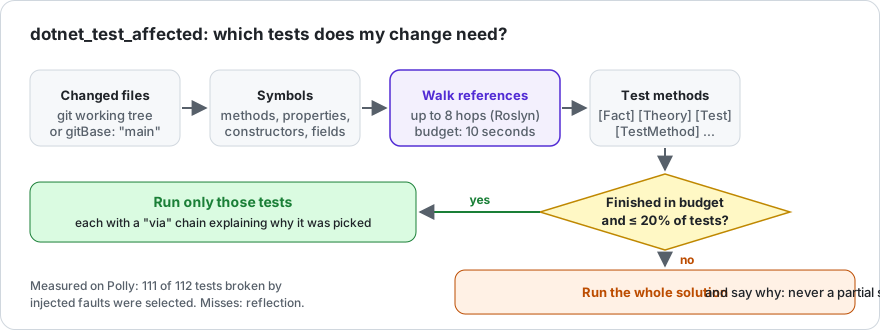
How it decides
sequenceDiagram
    participant Agent
    participant Tool as dotnet_test_affected
    participant Roslyn
    participant CLI as dotnet test
    Agent->>Tool: changed files (or git)
    Tool->>Roslyn: symbols declared in those files
    loop up to maxDepth hops, within maxSelectionSeconds
        Tool->>Roslyn: FindReferences(symbol)
        Roslyn-->>Tool: the members that use it
    end
    Tool->>Tool: which of them are test methods?
    alt finished, and at most maxSelectedFraction of all tests
        Tool->>CLI: one run per test project, filtered to those tests
    else out of budget, or too many tests
        Tool->>Tool: which test projects reference the changed projects?
        Tool->>CLI: only those test projects (or the whole solution if that's all of them)
    end
    CLI-->>Tool: TRX results
    Tool-->>Agent: results, the reason for each selected test (via), and what was run
- Changed files: from
changedFiles, or from git (uncommitted changes, orgitBase: "main"for a branch). - Symbols: everything the files declare that can run: methods, properties, constructors. A type or field hops through
its constructors (field initializers run there) and, for fields, through everything that reads them. That’s how xUnit
[MemberData]theories are found. - Reference walk: Roslyn finds every member that uses those symbols, then every member using those, up to
maxDepthhops (default 8). - Test methods: members with
[Fact],[Theory],[Test],[TestCase],[TestCaseSource],[TestMethod]or[DataTestMethod].
When it doesn’t filter by test name
| Situation | Why | What runs |
|---|---|---|
The walk didn’t finish within maxSelectionSeconds (10) |
The change touches code nearly everything depends on; tracing it costs more than running tests | The test projects that reference the changed projects |
The selection is more than maxSelectedFraction (20%) of all test methods |
A filtered run that large is no faster than running those projects whole (measured on Polly) | Same |
A changed file isn’t compiled C# (.csproj, .razor, appsettings.json, resources, a deleted .cs file) |
The reference walk can’t see it, but it can still break tests | The test projects that reference the project folder holding it; the file is listed in untracedFiles |
A build-wide file changed (.props, .targets, global.json, nuget.config, .editorconfig) |
It can affect every project | The whole solution |
| Every test project is reachable | Nothing to narrow | The whole solution, in one run |
The response says what ran and why: ranScope is selection, projects or solution, testProjectsRun lists the projects,
and note explains the reason. A partial selection is never presented as complete. The project step follows project
references only: a test project that uses the changed code through a NuGet package reference isn’t found. On a solution
where every test project uses the changed library (Polly and Polly.Core), this still runs everything; it narrows when
modules are independent.
Parameters
| Parameter | Default | Meaning |
|---|---|---|
changedFiles |
git working tree | Files to start from |
gitBase |
- | Diff against this ref instead, e.g. main |
dryRun |
false | Only list the tests and why |
maxDepth |
8 | Reference hops. 3 narrows more changes but misses tests reached through long call chains |
maxSelectionSeconds |
10 | Time budget for the walk |
maxSelectedFraction |
0.2 | Above this share of all tests, run everything |
framework |
all | Run one target framework, e.g. net10.0 |
noBuild |
false | Skip building the affected test projects |
timeoutSeconds |
600 | Kill the run if a test hangs; the response names the modules that never finished |
What it can’t see
- Reflection (
Activator.CreateInstance,GetMethod,BindingFlags), string-keyed lookups, and DI by convention (assembly scanning). A test that reaches your code only that way won’t be selected. On Polly this was the one miss out of 112 broken tests. - Documentation and files outside every project (
*.md, images, CI workflows) are ignored: they can’t break a test. - Calls through an interface or base class are followed: changing
OrderService.Submitselects a test that only callsIOrderService.Submit. - Hanging tests are killed after
timeoutSecondsand reported by module, not by test name (VSTest runs do name the test). - The first selection of a session on busy code can hit the time budget and run everything; Roslyn caches what it learned, so the same selection is fast the next time.
Test frameworks
VSTest (dotnet test classic) and Microsoft.Testing.Platform ("test": { "runner": "Microsoft.Testing.Platform" } in
global.json) are both supported, with xUnit v3 detected automatically and MSTest/NUnit handled through --filter.
DotNetDevMCP runs dotnet from your project’s directory, so your global.json (SDK version, test runner) applies.
Numbers: Benchmarks.